The combination is the object of design
For a century, the drug was the thing being designed.
We design the combination.
Our approach
1 of 3
Precision is not
the same as control
Cancer arises from the patient’s own cells. Their capacity to survive, divide and evade treatment can make a response temporary, as resistant cells persist or new routes of escape emerge.2 Effective treatment requires coordinated action across several vulnerabilities, rather than an ever more precise attack on one.
Cancer is a control problem. The challenge is to predict and design how living cells respond to coordinated interventions.
More possibilities
than experiments
A hundred drugs, each on or off, is more possible regimens than there are atoms in a human body. No lab can test them. So we learn from the experiments we can run, predict the rest, and work backward from the response we want.
Watch. Learn. Steer.
Three steps. One loop.
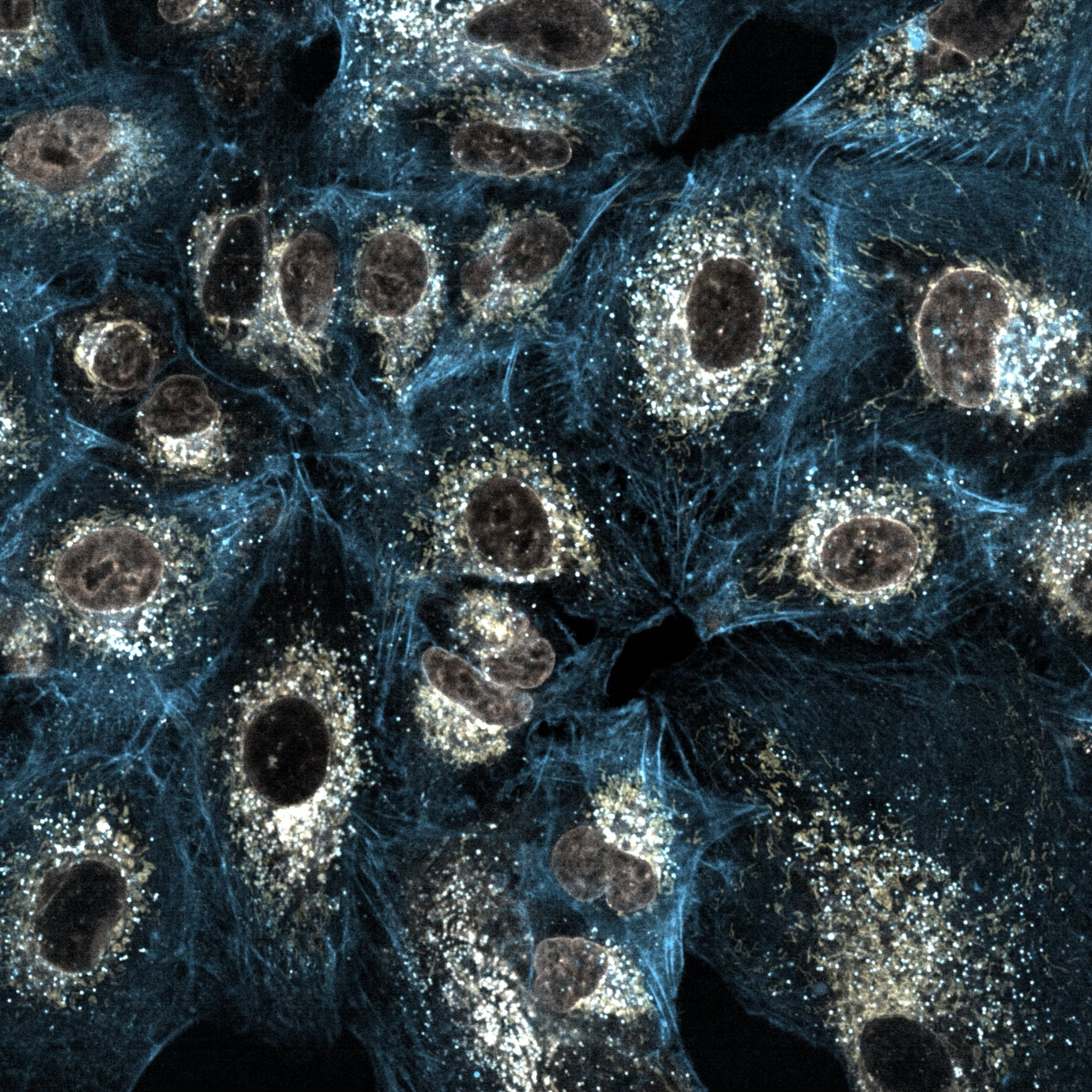
We image living cells before and after drug perturbations, following their responses over time. Established Cell Painting protocols use fixed cells.3 Our work follows cells that are still alive.
We train models on what the cells do. They predict how drugs and doses combine — which effects reinforce, cancel or alter one another.
The models design a combination for a chosen cellular response. The experiment tests it. The result trains the next design, failures included.
1 of 3
The lab
A lab that learns.
A model that experiments.
Biology has no internet to train on, so we generate our own data. We’re building the lab and the models together, with biologists and AI researchers side by side. Experiments inform the models, and models shape what we test next, all in a fully automated lab we designed and own.
How we keep score
A prediction has to survive the experiment
Our work is in the lab. We judge our models by predictions made before the experiment, results that reproduce, and real changes in what cells do. Added complexity has to prove it beats simpler alternatives. We’ll share progress openly, including what’s unresolved, and work with regulators early to meet medicine’s standard of evidence.
~1.5 million images of living cells a week.
Our plan: 100x that rate in the next 12 months.
Work with us.
We are hiring researchers and engineers. We also want to hear from oncologists, investors and regulators.